Rooted: From the Giving Tree to the Keystone Tree
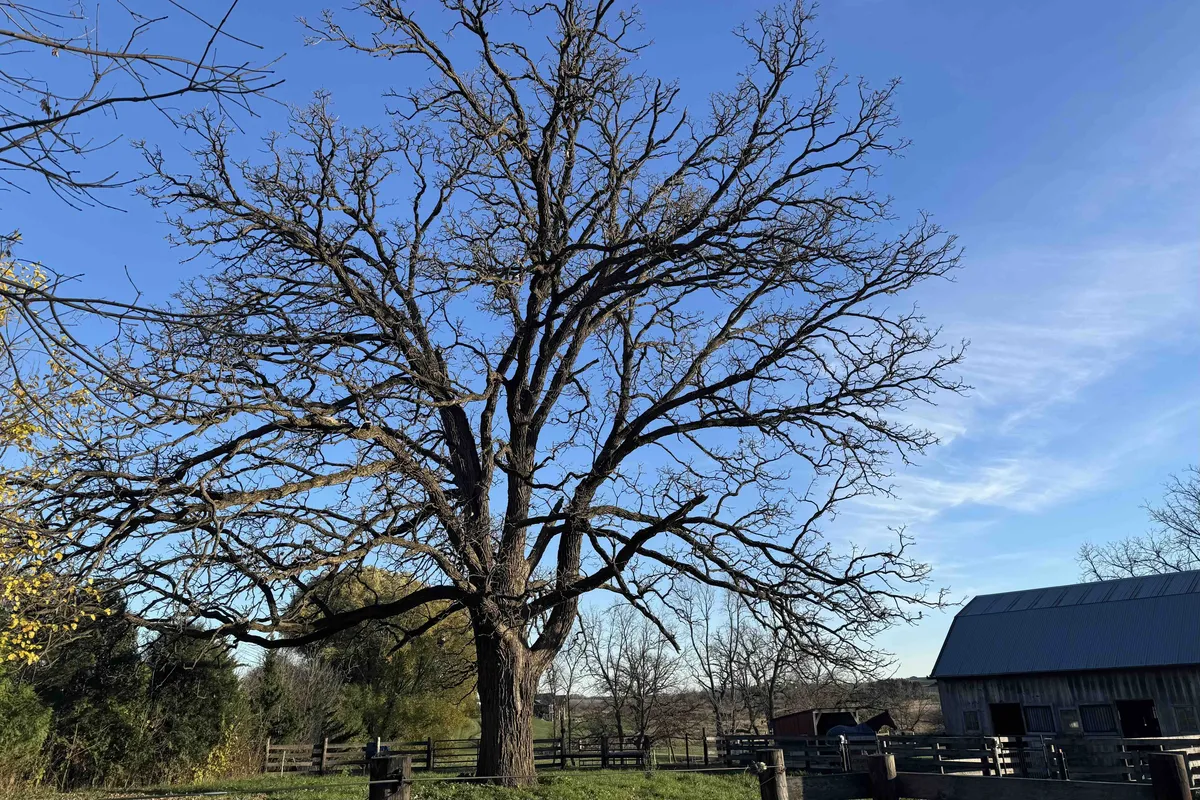
There is an oak tree on my farm that is over four hundred years old.
I have walked past it in every season — in the pale quiet of winter mornings, in the full cathedral green of summer, in the gold and amber blaze of autumn. I have put my hands on its bark and felt something that I can only describe as presence. It has outlived generations of people who stood exactly where I stand. It was here before this farm had a name. It will likely be here long after I am gone.
Recently, someone removed a fence I had placed around that tree to protect it. Horses were allowed to graze and move freely around its base, their hooves compacting the soil, cutting off the oxygen and water the root system needs to sustain itself. The damage was quiet and invisible at first — that is how the deepest damage often works. By the time I brought in an arborist, the tree needed real intervention. Real tending. A return to conditions that would allow it to heal and re-root.
I have been thinking about that tree almost every day since.
The Giving Tree and the Story We Recognize
Most of us know Shel Silverstein's beloved children's book The Giving Tree. A tree loves a boy completely and unconditionally. As the boy grows, he returns again and again — for apples, for branches, for the trunk itself — and the tree gives every single time, because giving makes the tree happy. By the end of the story the tree is a stump, and the boy is an old man, and he comes back one final time. He just needs a place to sit and rest. And the stump, with what little it has left, offers that.
It is a beautiful story. It is also, if you look at it honestly, a quietly devastating one.
I have loved that book my whole life. And somewhere in the middle of a hard season, I picked it up and realized I had been living it. Not because I resented giving — I don't. Giving is woven into who I am. But because I had confused giving without limits with loving without conditions, and those two things are not the same. Loving without conditions is a profound and worthy thing. Giving without limits — without roots, without boundaries, without a protected inner core — is a slow depletion that eventually leaves nothing standing.
The tree in that story had no boundaries. And so it gave and gave until there was nothing left to give. Its worth was entirely wrapped up in whether the boy came back and whether it had something to offer him when he did. That is not abundance. That is attachment disguised as generosity.
Many of us — especially those of us who are parents, caregivers, healers, and helpers — recognize ourselves in that tree more than we would like to admit.
A Different Kind of Tree
In a recent therapy session, my therapist offered me a different image to try on. Instead of the giving tree, she asked, could I be a keystone tree?
In ecology, a keystone species is one whose presence shapes and supports an entire ecosystem in ways far beyond what its size or numbers alone would suggest. A keystone tree — think of an ancient, deeply rooted oak — is one of the most generous organisms in nature. It gives shade and shelter. It produces food. It creates habitat for hundreds of species. Its root system holds the soil together and creates the conditions for other plants to grow. Its presence quite literally makes life possible for everything around it.
But you cannot take its trunk. You cannot remove its roots. You cannot strip it of its branches one by one until nothing remains. The keystone tree gives abundantly and freely — but it gives from wholeness, not from depletion. It gives from the overflow of what it is, not from a fear of what will happen if it doesn't give enough. And because it remains rooted and whole, it goes on giving for centuries.
That is the invitation. Not to give less. Not to love less. Not to close yourself off or become guarded or hard. But to give from a place so grounded, so rooted in your own sense of self and worth, that your generosity cannot be used against you. To love people fully while remaining fully yourself. To offer shade without letting anyone compact the soil around your roots.
What Compacted Soil Looks Like in a Human Life
In trees, compacted soil cuts off the oxygen and water the root system needs to function. The tree doesn't die immediately. It struggles quietly for a long time before the damage becomes visible. And if the conditions don't change, eventually the tree cannot sustain itself.
In our emotional lives, compacted soil looks like chronic boundary violations that we absorb without addressing. It looks like giving our resources, our time, our energy, and our sense of self in response to pressure rather than from genuine choice. It looks like relationships where our worth is contingent on what we produce or provide. It looks like slowly losing access to ourselves — our joy, our clarity, our groundedness — and not quite being able to name why.
Many of us walk around with severely compacted soil and don't realize it until a crisis forces us to call in the arborist.
A Gestalt lens asks us to become aware — really aware — of the patterns we are living in, the contact we are making or avoiding, the places where our energy is flowing freely and the places where it is blocked. Compacted soil is a Gestalt problem. It is what happens when we lose full contact with ourselves in the process of reaching toward others.
The healing, as any good arborist will tell you, is not dramatic. It is slow and intentional. You aerate the soil. You restore the conditions for roots to breathe. You protect the perimeter. You tend carefully and you trust the process. The tree does the rest.
The Season of Re-Rooting
I want to be honest about something. Becoming the keystone tree is not a destination I have arrived at. It is a season I am in. Some days I feel the full weight of my roots beneath me and I know exactly who I am. Other days I still feel the old pull — the urge to give from a place of anxiety rather than abundance, to earn love rather than simply offer it, to make myself smaller in hopes that peace will follow.
What I am learning is that re-rooting is not a one-time event. It is a practice. It is the daily choice to return to yourself. To ask not just what do others need from me today, but what do I need in order to remain whole. To love generously and to protect the conditions that make generosity sustainable.
The oak tree on my farm is being tended to right now. The soil is being aerated. The perimeter is protected. It will take time. But that tree has survived four centuries because its roots run deeper than anything that has ever threatened it. I have to believe the same is true of me.
And perhaps of you too, if you're reading this and recognizing something of your own story in these pages.
You are not a stump. You never were.
You are somewhere in the middle of becoming the oak.
Keep Reading: Everything Becomes Fertilizer (coming 11/10/2026), on what to do with the mess someone else leaves behind.